Wednesday, 8 August 2012

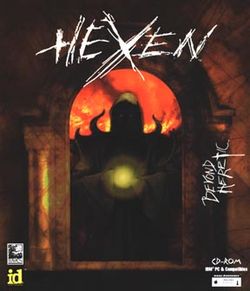
Hexen: Beyond Heretic

Game: Hexen: Beyond Heretic
Platform Played: PC 
Developer: Raven Software
Release Year: 1995
Stephen's Rank: 7/10

It's been a long time since I last posted! Having a baby plus a lot on at work has meant I've not had the time, but I fully intend to finish my blog and report on every game I've ever played.


Hexen is a first person shooter / role playing game developed by Raven Software.

Basic Plot

Following the events of Heretic the player travels to the realm of Cronos as part of a team of three heroes who seek to defeat the second Serpent Rider, Korax.

Gameplay

Hexen used the Doom engine and so by default was a first person shooter with additional functionality layered over top. The gameplay was similar to Heretic in most respects with some additional features:

  • Player character classes to choose from (fighter, cleric, or mage). Each character class had their own array of weapons and different physical characteristics; the fighter being the strongest and fastest but with little long range abilities, the mage being fragile but having powerful long ranged attacks, and the cleric being a blend of the two. The same item held by different classes could also produce different effects.
  • Unlike Heretic the game used a series of hub levels which the player would used to access other "side" levels but return to after. This allowed for large scale puzzles which involved interaction with multiple playable areas.
All in all the game was a first person shooter but with the addition of role playing mechanics such as items, abilities, and puzzles.


Comparisons

Of course, being the sequel to Heretic they are very similar to each other. For me, Hexen felt more epic. It took the game engine and twisted it enough so that it didn't feel like a generic first person shooter any more.

I can see some comparisons with Half-Life in the way they took the first person shooter genre but layered story and complex interactions that most other FPS games don't include.

It *almost* reminded me of Ultima Underworld... but had no-where near the depth of story or game mechanics.

Positives

Great music, fun to play, one of the most exciting games to be released at that time.

Negatives

I didn't play enough to find any for myself.

Memorable Moments

None.

Monday, 2 July 2012

Minecraft

Game: Minecraft
Platform Played: PC
Developer: Mojang
Release Year: 2011
Stephen's Rank: 8/10


Minecraft is the original sandbox adventure game which changed the way we think about games.

Basic Plot

There is no plot.

Gameplay

Regardless of what mode you play the game on there are some general principles which make Minecraft what it is:
  • The entire world is made up of 3D cubes of material somewhat like a giant lego world.
  • Different blocks have different properties and can be interacted with in different ways.
  • Some blocks can be harvested to obtain raw materials. These raw materials can be held in the player's inventory.
  • Raw materials can be combined in a number of ways to create complex tools, objects, and even engineering and electronics.
There are different modes of gameplay which provide the player with a different experience. Primarily there is survival mode and creative mode.

In survival mode the player joins or creates a random world to play in. You start with nothing except your bare hands and initially the goal is find food and shelter and survive. Gameplay is broken up into a fairly frequent day/night cycle. During the day the player is safe from enemy creatures and can focus on finding materials and food. At night time the player is encouraged to build or find shelter and wait for day time, as there are a multitude of enemy creatures who will try and attack the player on sight and even destroy their creations.

 An example of a player inventory. You can craft basic items from here in the space provided but you need a work bench to create complex recipes.

In creative mode the player is given a UI which allows them ot create an infinite number of any material. This is useful for creating masterpieces within the game engine. The objective isn't to survive, rather creative mode offers the player a canvas to create art.

The game is under constant development and from what I've read there will eventually be a way to beat the game, but for now it is truly a sandbox game which gives the player complete freedom to play in any way they choose.

Rather than talk in depth about the mechanics of the game I think it would be a lot more interesting to explore how we (myself and several others from Viva la Dirt League + my friend Matt) played Minecraft. We have a server hosted online and we play periodically. I'll cover that in the memorable moments section at the bottom

The work bench, used to create complex recipes.

You can also give your character custom skins which is always a source of entertainment. Mine is currently a Super Saiyan 3 Goku skin, while Hamish has a frog.

Comparisons

Obviously the closest thing I've ever played to this is Terraria which is essentially a 2D version of Minecraft. Terraria is slightly more adventure orientated and includes dungeons, boss monsters and quests which give it a slightly different feel.

Positives

Minecraft is a joy to play. It's deceptively simple from an initial glance, but has a lot of depth underneath. The vast array of recipes and interactions you can have with the world are immense and can provide you with many (many) hours of gameplay.

Multiplayer is the best. There's almost no point in creating wonderous works of art without someone to share it with.

Negatives

There is no online server for hosting your games, instead you need to set up your own server. This isn't an issue if you know how to open ports and set up a private server, or if you pay to have your server hosted, but if you don't know much about computers it can be a pain.

Memorable Moments

Myself and a group of friends have a server hosted online which we used to play a lot of.

We've set up a mini-town of sorts with different areas for different purposes. The areas are linked together with a powered rail which can be summoned from either end. I set up most of the rail and it was really fun. I highly recommend it! It makes any Minecraft town a lot more fun.

When we first started the server my friend Matt set up a basic base built into the side of a forested hill. We set up a basic living area with forges and work benches, chests for storage, and a wheat farm. We also dug a fairly winding mine shaft down to gather minerals.

From that area we built a tunnel which extends under the ocean a short way onto a large flat area of land. Here we decided to re-create the drama school that most of us went to for three years. It's a pretty unique building with a huge tall ceiling and lots of weird shapes and rooms, and it's still in progress. We call it "Te Whaea" which is the name of the building in real life.

A partially completed Te Whaea.

Next James and Paul set up a giant fortress in the middle of the ocean which looks like a giant head. I haven't had much to do with it but whenever I catch the train back to Te Whaea to see Matt... there it is, staring at me.

Then I had this "awesome" idea. I wanted to build a giant statue like the Collossus from Civilization but make it transparent and have light coming from inside it. I built a small base underneath and created a portal to the Nether. It turns out it looks freaking ugly and I hate it. I scorn the sight of it whenever I go past it now and will dismantle it in the future.

My failure of a statue.

Hamish creates his home base a fairly long way away in the side of a desert mountain area. It's huge and epic but the problem was it took us too long to meet up (this was before we laid down the rail). So we met half way and created a new home base. We included a vast array of farms with pigs, sheep, cows, chickens, wheat, watermelons, and bamboo up the top. A stone platform was our starting point and has become a sort of "hub" we use to catch trains and store items in a row of chests. There is a tunnel that goes through the mountain here toward Te Whaea but most importantly our mine shaft is in here. To get down you simply fall vertically to the bottom into a pool 3 tiles high of water. It's a rush every time I fall down. There's a second shaft with a ladder to the top and several exits at different levels; for example at the right levels for mining gold, diamond, or iron.

Hamish has extended the home base a lot including turrets, and we've linked all of our current and previous bases with a pair of railways. The goal is in the future to set up a circular railway which is always on with minecarts going past every few seconds. Then we can jump on from anywhere without having to call a cart.

Overlooking the top of our home base with the turrets and farmland visible. The mines are underneath. To the right in the distance you can see the transport hub with access to both railways and the storage chests. The stone path Hamish is on (he took the screenshots) is going to be part of the circular rail system.

Sunday, 1 July 2012

Black & White

Game: Black & White
Platform Played: PC
Developer: Lionhead Studios
Release Year: 2001
Stephen's Rank: 6/10


Black & White is an unusual strategy game developed by Lionhead Studios.

Basic Plot

The player takes on the role of a newly created god, created by the prayers of a small family. The player is then tasked at looking after the family with the help of his or her Creature.

The story kicks in when the player is introduced to another god called Nemesis. Nemesis is seeking to re-create the Creed so he can destroy all the other gods and become the one god to rule them all.

The player faces off against Nemesis by taking over villages and gaining pieces of the Creed until Nemesis is defeated leaving the player as the only remaining god.

Gameplay

The gameplay is pretty unique and doesn't have a lot of precedents before it. It plays out somewhat like a real time strategy game in that you are an external player who manipulates the world around them.

Here you can see the hand and a Creature.

The player's primary interaction with the world is the Hand. The hand follows the mouse cursor and is able to interact with many objects in the world including picking up and throwing objects (and people), casting miracles, knocking on houses to wake up the inhabitants, etc. The appearance of the hand changes depending on the actions the player takes (looking pure and clean if the player follows a strict no-harm policy to villagers, or red and spiky if the player commits evil acts).

The other primary form of interaction with the world is the Creature. Each god has a Creature which is a magical pet which can be trained to perform various tasks. The player trains the Creature by placing a leash on him while performing various acts with the Hand. The Creature AI remembers those actions and will repeat them automatically. Using this technique the player can train their Creature in any way they choose. Creatures grow in size and strength over time.

A lot of the gameplay involves taking over villages by performing miracles which cause the villagers to believe in you as a god. Other ways of winning over villages including providing resources such as food or wood, or creating a building.

As mentioned earlier the player gets a choice; whether to be a good and compassionate god or an evil twisted one. The choice is made by the actions the player takes, and the user interface changes depending on the player's alignment. Additionaly gods with different alignments will use different strategies in the game; a good god might provide care and help to a village while an evil god will strike fear into them in order to force them to obey. Villagers get immune to different kinds of miracle and help over time, so the player is forced to keep trying different tactics to impress them.

The player's temple, where the Creature sleeps and the player saves and loads their game.

There are two kinds of quests; golden scroll (primary) and silver scroll (optional). Silver scroll quests provide additional rewards which help the player advance.

Miracles are spells which the player casts with their hand. They cost worship or sacrifice to cast. To perform a miracle the player makes a Hand gesture which means the player has to remember the gestures for all the Miracles they know.

Comparisons

The fact that you play a god and are controlling the people not directly but indirectly reminds me of Populous 2.

Positives

Innovative idea, fun concept. Nothing like it out there (at the time).

Negatives

The story is a little weak.

For me the game missed the point of its own innovation. The story is actually quite restrictive and forces the player into situations where their freedom to explore is reduced significantly. I think this game would have had more success in a sandbox environment where there wasn't necessarily any story.

Memorable Moments

No matter how hard I tried I always ended up sliding toward evil alignment. It's very tricky to stop your Creature from accidentally eating villagers... It got too hard for me, I stopped enjoying it once I encountered other gods.

Thursday, 28 June 2012

Final Fantasy Tactics A2: Grimoire of the Rift

Game: Final Fantasy Tactics A2: Grimoire of the Rift
Platform: Nintendo DS
Developer: Square Enix
Release Year: 2007
Stephen's Rank: 9/10 


Final Fantasy Tactics A2 is a turn based combat strategy game for the Nintendo DS.

Basic Plot

You play a young boy named Luso Clemens who finds a strange book in the school library which has blank pages, and is sucked inside it. He finds himself in a strange world called Ivalice.

Upon arriving in Ivalice he chances upon a battle between a group of people who call themselves a "clan" and a giant bird called Klesta they're trying to defeat. Their leader, Cid, asks Luso to join his clan to protect him. He swears loyalty to the clan in front of a Judge and gains protection from death in doing so.

The story involves Luso working together with his new clan to try and find a way home. He decides to help the people of Ivalice while he searches.

A wise sage called Lezaford tells Luso that if he continues questing with his clan he will fill the pages of his grimoire (the book that took him to Ivalice) and in doing so he will find a way home.

On his journey Luso and his clan battle against a strange organisation known as The Khamja who are plotting and doing evil deeds around Ivalice, which comes to a head in the end of the game.


Gameplay

Final Fantasy Tactics A2 is a turn based combat strategy game. The game is broken up into two main stages; an over world which allows the player to travel to different battles and towns, and the battlegrounds themselves.

In the over world the player can move around freely without being engaged by enemies. The world is broken up into "areas" such as "Camoa" or "Baptist Hill". Each area has a small number of tiles which may or may not contain a battle depending on what quests the player has picked up. The overworld also contains towns and cities, as well as some other areas such as the Lezaford's house in the Aldanna Range or the witches hovel in Tramdene Fens. Towns provide you with two primary functions; the pub and the shop.

The over-world. The area shown is Camoa.

The pub is where you get quests from. It's also where you can read notices and rumours. I find this a bit confusing; they're both just notes which you can read with some backstory to some side quest, which sometimes trigger quests in the quest list. You can also sign up for clan trials to obtain new clain privileges here.

There are two currencies in the game world. Gil is like "gold" and is used to buy items and sign up for ordinary quests. Clan points are used for competing in clan trials, as well as for buying extra tokens at the auction house (more on that later). Both are obtained by completing quests. I generally find I have a massive stockpile of clan points but just enough gil to buy all of the recipes I have available.

The shop serves to provide your party with weapons, armour, and items. When you first use the shop it is mostly empty. During battles you obtain ingredients of all shapes and sizes which can be combined together in the bazaar (an area of the shop). Once you create the recipe for an item is available to purchase from the shop from then on. There are some exceptions as there are items which you can only purchase one of unless you re-create the recipe in the bazaar. This is a pretty fun and satisfying minigame that takes place between battles and allows you to build up your equipment over time. It also allows you to manipulate the rate at which you unlock recipes by using the Thief job (and stealing additional ingredients during a battle) as well as making sure you check chests and urns on every battle field. There are other ways to obtain items, both from battles and from the auction house.

At this point it's worth explaining the game world a bit further...

In Ivalice there are beings called Judges who are assigned to clans. A clan is a group of adventurers who complete quests for the various people of Ivalice. A judge provides the clan with immortality in battle; a clan member can be defeated in battle but does not permanently "die" as long as they have the protection of a Judge. The sacrifice is that the Judge imposes a law on every battle which the clan must adhere to. If the clan breaks the law, they forfeit their protection for that battle. An example of a law might be "You cannot use fire". This means you need to avoid using spells or weapons which do fire damage in order to stay under the protection of your judge.

The flip side to laws are clan privileges which are bonuses that the clan receives as long as they are under the protection of their Judge. An example of a clan privilege is "Regen" which causes every clan member to renegerate a small amount of health at the start of their turn. Clan privileges are also lost if you break the law during a battle, and new privileges are unlocked by completing special quests called clan challenges.

In each battle you take control of between one and six members of your clan. Your clan can contain up to twenty four members in total but because you generally only take six into battle you'll have a main "team" and then back-up members to fill different roles.

Clan members gain strength in two ways. Each clan member who participates in a battle gains experience which over time allows them to level up. You can go up to level ninety nine. This means that your primary party will become a lot stronger than the rest of your clan over time. This purely increases the health, attack damage, speed, resistance, and magic damage that your party does.

Each clan member also chooses a job. A job is simply a character class, and each clan member can use one primary job but also access the abilities of a second job. For example; you could have a Hume Soldier in your party who also has access to whatever White Mage abilities he or she had previously learnt. This allows for some pretty interesting combinations. On top of that each clan member also has a reaction ability and a passive ability. Reaction abilities are triggered when the clan member gets attacked in combat. An example is "Counter" in which the clan member will counter-attack any opponent who attacks them from melee range. Passive abilities are active all the time and include skills such as "Dual Wield" which allows you to equip two weapons and "Shieldbearer" which allows you to hold a shield regardless of your primary job. Some jobs have special requirements before they can be used, often including have a certain number of previous abilities in another job (for example you need White Mage abilities to use the Seer job).

Example of a battleground with the clan members to the right.

Each job has a set number of abilities which can be learnt. The trick is that you need to find certain pieces of equipment which "teach" you the ability if you wear them. So a Thief might equip a small sword called the Rondel, which teaches them the ability "Loot Lvl 2". The way this works is that after every battle your entire clan (regardless whether they are in the battle or not) will receive skill points. Usually 30 points for a normal quest and 80 for one that follows the main story. Say, for example, that "Loot Lvl 2" requiers 200 skill points. This would mean you'd have to equip the sword for seven normal battles before your Thief "learns" the ability. Once it is learnt you can access the ability without holding that item anymore as either your primary or secondary job. It sounds a little complex but it's not and the game slowly introduces these concepts over time. It interlinks the concept of loot with character development in a really nice way - you have to find good items to give your clan members good abilities.

On top of that, each clan member can be one of several races. Unlike Earth, Ivalice is home to a variety of beings and each race has their own set of jobs which can be picked up. Here is a list of the different races along with the jobs they can pick up:

Hume (human): The most common race in Ivalice and with the largest and arguably the most powerful set of jobs available to them.
  • Soldier; A melee warrior.
  • Thief; A light warrior with the ability to steal items from foes. This allows you to obtain ingredients for the bazaar faster than you normally would be able to.
  • White Mage; Classic healer.
  • Black Mage; Classic elemental damage dealer.
  • Archer; Ranged warrior.
  • Paladin; Defensive melee warrior with special offensive ability against the undead.
  • Fighter; More powerful melee warrior than the Soldier with a variety of powerful attacks.
  • Parivir; Stealthy warrior, reminds me of a samurai.
  • Ninja; Quick melee warrior with low defence. Can learn "Dual-Wield" which is extremely powerful (two attacks instead of one, and allows you to learn more abilities at once).\
  • Illusionist; A wizard who can cast spells that damage every enemy on the battleground with a variety of damage types (elemental, holy, earth, etc).
  • Blue Mage; A mage who learns the abilities that monsters cast on them. The trickiest class to master and you will definitely want a Beastmaster in the party to help you achieve this.
  • Hunter; A powerful ranged warrior with the infamous "Ultima Shot" ability.
  • Seer; Similar to the Red Mage but with more powerful versions of the spells. Has the "Magick Frenzy" ability which allows it to cast a spell and then attack that enemy with a weapon.
Moogle: These are small, cute, furry humanoids who say "Kupo!" all the time (it gets pretty annoying).
  • Animist; A healer/support caster.
  • Thief; Same as Hume.
  • Black Mage; Same as Hume.
  • Moogle Knight; A melee warrior with versatile abilities. Similar to the Fighter.
  • Fusilier; Ranged gun-wielding warrior with a huge attack range.
  • Juggler; Ranged support who uses cards as a weapon. Has an arsenal of buffs and debuffs.
  • Tinker; Worst job in the game. All abilities are based on luck, and if the luck is against you then the spells will damage your party instead of your enemies.
  • Time Mage; Can alter time. Very useful; especially "Haste"/"Hastega" and "Quicken".
  • Chocobo Knight; Rides a chocobo and gains abilities based on the colour of the chocobo.
  • Flintlock; Similar to the Fusilier but has to "prime" before they can fire their weapon. Makes it pretty useless.
Nu Mou: Chubby rabbit like creatures with an affinity for magic.
  • White Mage; Same as Hume.
  • Black Mage; Same as Hume.
  • Time Mage; Same as Moogle.
  • Beastmaster; Can control monsters in battle. Important if you want to train up a Blue Mage.
  • Illusionist; Same as Hume.
  • Alchemist; Spell casting class which does good damage against a single enemy and utilises poison damage.
  • Arcanist; Specialises in dark and holy damage.
  • Sage; Powerful caster.
  • Scholar; Casts spells which damage every unit in the battle (including allies...).
Bangaa: Kind of like a cross between a lizard and a dog... physically strong.
  • Warrior; Much like a Soldier.
  • White Monk; Combines defensive abilities, bonuses against undead, and some healing into a melee warrior.
  • Dragoon; Wields lances with a long range and has a variety of powerful attacks.
  • Defender; Similar to a Paladin.
  • Gladiator; High damage dealing melee warrior.
  • Master Monk; Has a variety of powerful attacks.
  • Bishop; A healer class.
  • Templar; A melee damage dealing extension of the Bishop.
  • Cannoneer; Ranged warrior who uses shoulder cannons.
  • Trickster; Ranged damage dealer support unit.
Viera: Always female and have rabbit ears.
  • Fencer; A melee damage dealer with utility abilities.
  • White Mage; Same as Hume.
  • Green Mage; Has a variety of support abilities and is quite physically strong too.
  • Archer; Same as Hume.
  • Elementalist; Has a variety of elemental damage dealing spells.
  • Red Mage; A mix of both Black Mage and White Mage abilities. Also has the Doublecast ability which lets them cast two spells at once.
  • Spellblade; Melee warrior who imbues their attacks with various debuffs.
  • Summoner; Powerful casting class with a mix of healing and damage dealing.
  • Assassin; Has both ranged and melee weapon abilities.
  • Sniper; Improved version of Archer.
Seeq: Portly round people who are physically powerful.
  • Beserker; Damage dealing hand to hand combat.
  • Ranger; Lays traps.
  • Viking; Wields axes and has some magical ability.
  • Lanista; Powerful melee warrior with lots of utility.
Gria: Always female and have wings that let them fly in battle (useful for getting across certain areas or up high).
  • Hunter; Same as Hume.
  • Raptor; Similar to Fighter, melee damage dealer.
  • Ravager; AOE melee fighter.
  • Geomancer; Utility spell caster.
There are also secret or special jobs available to certain characters in your party including the Heritor for Adelle, and the Bard for Hurly.

So there's a lot to decide when you choose who is going to be in your main team and there is a lot of replayability if you wanted to experience how other jobs work after your first play through.

Combat occurs on a small battleground which consists of tiles. Each clan member and enemy takes turns at moving and/or using an ability. Positioning is important; you do more damage to an enemy if you're standing behind them than in front.


There is one other activity which occurs in the over world every 200 days which is the auction house. This is a minigame within the game which gets the player to bid "tokens" against several AI opponents and try and stay in the lead. Tokens are worth 1, 2, 3, or 5 and you can "run out". The game involves trying to stay ahead of your opponents without running out of tokens (and therefore losing in later rounds). There are bonuses within rounds which give players an extra 5 token for finishing in a particular position at a particular stage. For example; on the third stage of bidding there might be a reward for being in 2nd place. Auction houses are situated in all the main cities and by winning an auction you take control of the corresponding "area". It's a little confusing at first but ultimately when you win auctions when you already control the area you are eligible to win powerful items of equipment. It's a great way to pick up some of the top end weapons and armour you might not have been able to source from the bazaar.

Comparisons

There are elements of many games but I've never played anything exactly the same before. It has the same feeling as one of the other Final Fantasy games in terms of the story, game world, and the characters. I like that. On the flip side, the battles themselves remind me more of Advance Wars in the way they play out. It's quite pleasing for me to be able to say there isn't anything else out there which is quite like this game.

Positives

The one thing that drives me nuts about previous Final Fantasy games are the random monster encounters in the overworld. You can't go anywhere without being constantly attacked by enemies. It makes exploring and travelling around the game world a painful and tedious experience. It's like playing a game of Pokemon where there is tall grass EVERYWHERE. Not fun. Final Fantasy Tactics A2 fixes this issue by changing the focus away from the overworld and making it all about the battles. The game world is tiny, and easy to travel around. It is a breath of fresh air in a genre that I was about to give up on.

The combination of interesting and challenging battles, plus the metagame of collecting items and choosing jobs for your clan members is totally enthralling. I've loved playing this game more than I would have ever expected and highly recommend it.

Negatives

I hate the sky ferry. You have to use it a lot and I just wish I could travel between continents quickly but instead you have to listen to some lady talk over and over again on each side. The music in the terminal is also the only annoying music in the game.

For anyone who's played Final Fantasy Tactics Advance, they've removed the law card mechanic where you could apply different cards to help you in different situations. That could be seen as a negative as it was a really interesting mechanic which added a new level of strategy to each battle.

Memorable Moments

All jobs are not equal! There are certain some "poop" jobs and some amazing ones, and there are certain combinations which are overpowered:
  • Humes can combine the "Magick Frenzy" ability of the Seer (which lets you cast a spell and then attack) with the Illusionist job. Illusion spells hit every enemy on the map, meaning you can damage every enemy with both your spell and your weapon. This is even further enhanced with the Illusionist passive skill "Half-MP" which halves the magic points required to cast spells. If you also use the clan privilege "MP Channelling" during a battle you can cast this deadly combo every single turn. This is the most overpowered combination in the game + the fact that Humes can learn Dual Wield means they pick up most the skills faster too.
  • My personal favourite job is the Viera job Summoner. All Summoner spells affect a wider area and they are a mixture of damage dealing and healing. My personal favourite spell is "Kirin" which puts health regeneration on everyone in an area. I cast this before most battles and one cast can hit the whole party.
  • My main character is a Blue Mage/Hunter. I chose Blue Mage for the challenge of learning the abilities plus the utility of the spells, and Hunter is ideal because it gives you a solid damage dealing class. If you learn the Illusionist "Half-MP" passive ability and also use "MP Channeling" as your clan privilege you can use "Ultima Shot" every single round.
  • Beastmaster is terrible, and to me it was only included to help you train up your Blue Mage.
  • Tinker is the worst class in the game. The spells randomly affect either your allies or your enemies. It's a gamble, and the odds just don't stack in your favour in a long battle.
I am still playing this game as I write this blog. I play it mostly on the train on the way to work but also sometimes before bed and in the weekends. It's addictive, satisfying, the best Nintendo DS game I've ever played (better than Pokemon Platinum in my opinion).

A big thank you to DRTwoadism (Hamish Woodman) for recommending me this game!
Tuesday, 19 June 2012

Ultima V: Lazarus

Game: Ultima V: Lazarus
Platform: PC (using the Dunegon Siege engine).
Developer: Team Lazarus
Release Year: 2005
Stephen's Rank: 5/10 (1/10 for game engine, 8/10 for game)


Ultima V: Lazarus is a complete re-make of Ultima V: Warriors of Destiny using the Dungeon Siege engine. It's free to play if you own a copy of Dungeon Siege and was entirely developed by fans of the original game.

Basic Plot

I reviewed the original game back in October 2011. For an overview of the plot (which is the same in this re-make) check out my original blog post:

http://avideogamediary.blogspot.co.nz/2011/10/ultima-v-warriors-of-destiny.html

Gameplay

Although the story and concept behind the game are the same as the original, the transition from 2D top down RPG to 3D RPG has changed the dynamic of the game significantly.

Firstly, the obvious. The original game was a 2D tile based game built for much older computers. The Dungeon Siege engine is a fully featured (although already out-dated) 3D game engine where the player is able to move the camera around the playable characters. The aeshetic is entirely different. Here is a comparison:

The original Ultima V: Warriors of Destiny.

Ultima V: Lazarus
 
Partly because of the change in game engine there were several spells from the original game which couldn't be ported to the re-make. There were a lot of other gameplay elements which were changed; for example there was no magic carpet, a lot of quests were added, etc.

One major difference is that a lot of the dialogue was re-written for the re-make to keep the same story but enhance the philosophical discussion of the virtues as well as to reveal more about the characters in the story.

Apparently there is an alternate ending where the Avatar can make sure Lord British never returns...

To be honest, I only spent a couple of hours with this game so it's hard for me to fairly assess the game engine. For one, it was heavily outdated even by the time it was released in 2005, and in my opinion the camera for one is hard work to use. There is no "follow cam" like you'd find in Neverwinter Nights, instead it seemed to me that you had to constantly adjust the camera to get the right view for each fight or activity.

Positives

For one, this is a fan re-make project which succeeded. I applaud Team Lazarus for their effort! This almost never happens, every project fails somewhere along the line.

The game world is beautiful. It's astoundingly crafted, and as I walked around Britannia I felt a huge wave of nostalgia and wonder. It was intense to see Britannia in such a vivid way.


Negatives

To me, the Dungeon Siege engine is the only weakness. It made the game unplayable for me. I found handling the camera and the interactions clumsy and a "chore" to work with. If it were not for this, maybe even just a nice follow cam, I may well have played this game through to completion, as I have always wanted to experience this story for myself (I was an infant when the original came out).

Memorable Moments

I only played it for two hours, but I was really sad the engine didn't suit me, as the game content itself looks incredible.

Monday, 18 June 2012

Dragon Age: Origins

Game: Dragon Age: Origins
Platform: PC
Developer: BioWare
Release Year: 2009
Stephen's Rank: 5/10


Dragon Age: Origins was the long awaited RPG by BioWare.

Basic Plot 

Firstly, it should be noted that Dragon Age is not set in the "D&D world" as was the case for their previous titles Baldur's Gate, Icewind Dale and Neverwinter Nights. This game is set in an entirely new world.

The player takes on the role of an adventurer who joins an organisation called the Grey Wardens who are tasked with defending the realm. The joining ritual involves consuming Darkspawn blood which will either kill the initiate, or imbue them with power called the taint.

There is a "blight" which is ravaging the land of Ferelden and the story involves unravelling the cause and looking for a cure. The blight involves enemies called Darkspawn appearing all over the land and ravaging it.

During a battle near the beginning of the game the player is charged with lighting a signal fire so that Loghain knows when to attack the incoming Darkspawn. However, upon lighting the fire, Loghain betrays you by leaving the battle and leaving King Cailan and Duncan (your guardian) to die among countless others.

The goal of the player from then on is to unite the forces of Fereldon to strike down and defeat the Archdemon, ending the blight once and for all. Using a series of old treaties signed between various factions and the Grey Wardens the player must unite the Dalish Elves, the Dwarves, the Circle of Magi, and the Arl of Redcliffe. However, all of these factions are facing troubles of their own which the player must help solve.


Back in the capital Queen Anora takes over rulership from her husband by Loghain declares himself regent and effectively takes over the kingdom, starting a civil war between himself and the nobility.

When the player finally gets all the factions to unite they gather at the Landsmeet to discuss their strategy. There, the player confronts Loghain after gathering full support from the nobility. Loghain is either executed, or renounces his past behaviour and joins the Grey Wardens to make up for his wrong doing (depending on the player's choice).

It is also revealed that only a Grey Warden can kill the Archdemon, and whoever makes the final killing blow will also die.

The final confrontation can end multiple ways; either the player dies, Alistair or Loghain die (if they make the final killing blow), or Morrigon's unborn child becomes a demigod.

One of the companions, Morrigon, who sounds like chef Nigella Lawson.

Gameplay 

Dragon Age is a third person role playing game with a similar feel the previous BioWare titles Neverwinter Nights and Neverwinter Nights 2 as well as Star Wars: Knights of the Old Republic.

The player creates a character with a race, gender, and also an "origin". This origin affects how the early stages of the game play out. For example; there are entirely different stories for a human noble, a human mage, and a dwarf commoner. The stories all merge together fairly early on, but it gives some replayability for that early section.

Each character had a "class" which defines their skills but also each class has a set of specializations which can be taken after advancing to a certain level:
  • Mage
    • Arcane Warrior
    • Blood Mage
    • Shapeshifter
    • Spirtual Healer
  • Rogue
    • Assassin
    • Bard
    • Duelist
    • Ranger
  • Warrior
    • Beserker
    • Champion
    • Reaver
    • Templar
The player takes up to three companions with them at any one time, but has a larger pool of characters to pick from if he or she chooses.

There is a favour mechanic with members of your party. You can bribe them, give them gifts, and they respond to how you behave in the game. Favour unlocks options for different companions, including romances.

The battle mechanic is that the action occurs in real time, but the combat can be paused at any time while commands such as spells or special moves can be issued. This is the same mechanic as many other previous BioWare games and has a nice balance between methodically planning a battle and also getting down to the action.

One nice mechanic was the interactivity between spells. For example; you could cast "grease" to lay down an oil slick and then set it alight with a fireball spell.

Quests could be tracked using a journal, but I found this quite unintuitive and I ended up writing a lot of stuff down on paper to keep track of it.


Positives

You can't deny it was a massive game with huge scope and a lot of detail. The combat mechanics work well and battles are pretty enjoyable. It also looked great.

Negatives

The game uses a tried and trusted formula, built up over many years - yet it just fell flat for me. I'm not sure if it was the lack of humour in the game, or the way the quests really felt like grinding, but I didn't enjoy playing this game - it felt like work. So I stopped after tasting the abilities of the Blood Mage.

I'm not even sure why, but I felt Neverwinter Nights 2 was infinitely more enjoyable. It could have been that it just didn't take itself as seriously as Dragon Age did. There was a lot of expectation on this game from players, especially naming itself the "spiritual successor to Baldur's Gate" and that didn't help.

I actually can't quite put my finger on what it was missing (or what there was too much of) but it just didn't work in my opinion.

No multiplayer! If I could have played the campaign co-operatively I think I'd have a completely different opinion of this game.

Memorable Moments

My character was a mage who I specialized as a Blood Mage. That was tricky because a mage uses mana to cast spells, whereas a blood mage uses their own life force (they take damage). So as a mage I had to put all my points into vitality which made me very weak until the specialization became available. I was godly powerful, but the game was so long and tedius I just gave up at the Landsmeet.

Wednesday, 6 June 2012

Christmas Lemmings

Game: Christmas Lemmings (Holiday Lemmings in North America)
Platform: PC (originally Amiga)
Developer: DMA Design (now Rockstar North)
Release Year: 1991 - 1994 (a release each holiday season)
Stephen's Rank: 5/10


Christmas Lemmings was a series of versions of the game Lemmings which were released during the holiday season. The games always had a Christmas theme. In 1991 and 1992 the games were released as demos with a few short levels. In 1993 and 1994 the games were sold in stores and contained a full compliment of levels.

Basic Plot

There is no plot but the scenario is that there are a group of suicidal lemmings who start at one point in the level and keep walking until they die or they reach the exit. Your job as the player is to keep them alive.

Gameplay

Lemmings is a puzzle game which involves interacting with and herding a group of lemmings from one side of the level to the other.

The game is divided into levels. Levels contain both destructible terrain and non-destructible objects such as steel walls. Levels also contain obstacles designed to kill your lemmings including high walls or steep drops, lava or water, and booby traps.

A player can complete a level with some losses but a certain percentage of their lemmings need to survive to complete it.


To navigate their lemmings through a level the player assigns skills to their lemmings. Skills are one-time-use and there are limited available so they must be used sparingly. The skills include:
  • Bashers; lets a lemming dig horizontally across.
  • Miners; lets a lemming dig diagonally down.
  • Diggers; lets a lemming dig directly down.
  • Builders; can create a rising staircase upwards.
  • Blockers; re-direct any lemmings who contact them back the way they came.
  • Bombers; continue walking for 5 seconds and then explode, taking out terrain with them.
  • Climber; can climb up a vertical wall or any slope at less than 180 degrees.
  • Floater; can survive falls no matter how high.
Floaters and Climbers are skills that last an entire level once given. A Floater who is given the Climber skill or vice versa becomes an "Athlete".

There are four difficulty levels; fun, tricky, taxing, and mayhem.


Positives

Excellent music. Challenging and unique gameplay.

Negatives

A little too difficult. Relentless even.

Memorable Moments

My mother LOVED the music from this game. For some context, I used to record some of the music from my favourite computer games using a microphone and an old cassette recorder. I created a series of albums I called "Computer Music" (inventive I know) and I'm pretty sure mum asked me to record the music from this game so we could play it at Christmas one year.