Tuesday, 25 September 2012

Flashback


Name: Flashback
Platform: PC
Developer: Delphine Software
Release Year: 1992

Basic plot
You play as agent Conrad B Hart. Awaking in a jungle having had your memories erased you must regain your past and thwart an intergalactic alien conspiracy.

What's its deal?
It's sci-fi Prince of Persia with a gun.

Level 1 - techno jungle

Gameplay
Like I said, PoP with a gun. It's a platform action game with some puzzles thrown into the mix. You move from screen to screen like in PoP climbing, leaping, hanging and blasting baddies. 
The graphics were nice for the time (especially the backgrounds), the story was a little bit “huh? Whatever” but what was awesome though was the feel of being an action hero. 

The act of simply drawing your gun, having it at the ready, aiming, shooting, readying and finally holstering looked so cool you wanted to slow down and enjoy every battle, not just power through the game. 
Combining human-realistic athleticism and slick, secret agent style movements led to lots of Jason Bourne style kills and level navigation - “I'll leap over this chasm, go into a dive roll whilst simultaneously drawing my piece and smoke this sucka”. I'd find myself humming the Mission Impossible theme whilst clearing screens and even restarting from save points just so I could take out guys and a cooler way.

Memorable moments
Spending way too much time on interesting screens practicing ninja style, gun-fu moves long after I'd killed everyone.

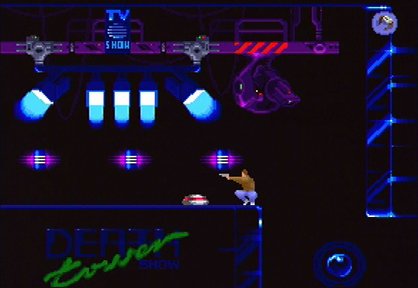
Death Tower had a very 'Total Recall' feel to it

Positives
  • Futuristic sci-fi setting is interesting with quirky little details (the subway system on level 2 taking you to 'continents')
  • One of the most satisfying games to fire your gun (gun sfx were gritty and loud too)
  • Nice mix of action and puzzle.
  • You feel like a FBI space ninja.
Negatives
  • Too short, only 7 levels.
  • Not enough enemies to kill, could have used a climactic fire fight.
  • It's French.

Extra comments
This was a really fun and satisfying game. Unfortunately it is tainted by its less successful (lame) sequel 'Fade to Black' where they tried to make Flashback 3D. This ambitious makeover took out all the fluidity of Conrad's movement and slickness. It was clunky and NOT FUN. Urgh.

Sunday, 23 September 2012

Blood

Blood


Game: Blood
Platform: PC 
Developer: 3D Realms, Monolith Productions.
Release Year: 1997

Setting

The setting is somewhat ambiguous but contains elements of post World War I Europe and America. The levels contain aesthetic choices from the 1920's - 1940's. This is strangely crossed with retro future-technology (reference to Tesla) as well as classic Western (including the background of the main character Caleb).

Basic Plot

You play a risen (undead) anti-hero from the Wild West era named Caleb. Originally Caleb was the commander of a cult called The Cabal who worshipped the god Tchernobog. He, along with four others, were the highest ranking members of The Cabal and were referred to as The Chosen. However, for an unspecified "failure" all four of The Chosen were betrayed and killed by Tchernobog. The game starts with Caleb rising from the grave. The original game is broken up into four episodes.

  • Episode 1: The Way of All Flesh: Caleb awakes from his tomb and immediately begins hunting Tchernobog's minions. Caleb hunts down and defeats the gargoyle Cheogh (one of  Tchernobog's minions), and cremates the body of one of The Chosen "Ophelia".
  • Episode 2: Even Death may Die: Caleb hunts down the spider demon Shial and defeats her. There he rips out the heart of the corpse of Gabriel (one of The Chosen) and absorbs his power.
  • Episode 3: Farewell to Arms: Caleb takes on the two headed beast (and second in command to Tchernobog) Cerberus and defeats him.
  • Episode 4: Dead Reckoning: Caleb fights his way to face Tchernobog himself. He ends up having to defeat his three lieutenants once again, before finally confronting the dark god. He finally learns why Tchernobog betrayed him; he knew Caleb would rise again and come back for him, absorbing power as he went, and Tchernobog wants the power for himself. Instead, Caleb states "It's time to put you down" and defeats the dark god - temporarily ending The Cabal.
The flair gun during the single player campaign.

Gameplay

Blood is a first person shooter based on the Build Engine. Although not true 3D (it used raycasting like technology seen in other games of the time such as DOOM or Wolfenstein 3D, it did include some voxel graphics for weapon pick-ups.

Blood was one of the last first person shooters I played purely with a keyboard (before the mouse + WSAD keys became the norm for PC games).

The single player campaign was interesting. It was littered with references to popular culture such as films, books, television, and various genres. It also featured a lot of blood and gore which makes the game fit into the "slasher" genre.

There were elements of puzzle solving as well.

Multiplayer LAN was one of the highlights of the game. The weapon options were spectacular and interesting, and some of the maps were pretty well designed too. The weapons included:

  • Pitchfork; the player's starting weapon, melee only.
  • Flare gun; a pistol which fired a flare which could "stick" to an opponent and continually burn them. An alternative fire could cause it to explode on impact.
  • Sawed off shotgun; always good at close quarters.
  • Thompson's machine-gun; standard automatic machinegun.
  • Aerosol can; used with a lighter to become a flame thrower. Powerful but you had to get close to hit an opponent. Could set the enemy on fire.
  • Napalm Launcher; fired a gooey projectile of death. When you get this weapon and fire it sometimes Caleb says "I love the smell of napalm in the morning".
  • Dynamite bundle; Used like a grenade.
  • Voodoo doll; Only in multiplayer, this weapon could either be used for a quick "stab" attack or a sweeping attack which could kill an opponent outright if they were close enough.
  • Skull staff (don't know the real name); this weapon was a skull on a staff which fired "hellfire" attacks at the enemy and was easily the most powerful weapon in the game.
  • Proximity mine; This mine had a sensor and if you stepped on it, it exploded. There was one multiplayer level called Click! which had a lot of these, was a small map, and often ended up with two players pretty much stuck until someone set off a chain reaction which almost eliminated everything on the level.
Voodoo doll.

Positives

The game was different, interesting. It had a really different feel to it even though it used a similar game engine to many others of the time. It had a lot of thought put into the back story and the connections with popular culture. The story was one of the better first person shooter stories out there, although still pretty linear in nature.

Multiplayer was amazing, it was something we played a lot of up until the age of real 3D games came along (particularly for is Half-Life Deathmatch). Going back from mouse+keyboard to just keyboard is PAINFUL.

Negatives

Having mouse + keyboard as an option would have extended the shelf life of this game for me.

Memorable Moments

Definitely the multiplayer level Click! was the most fun. I loved that... we knew where the spawn spots were and we'd lay mines down on them, so if you died you usually insta-died maybe 3-4 times before the mines were cleared.

I remember another level which had the skull staff, and there was a large spiral staircase up to it with a voodoo doll on the way. Lots of passages and positioning involved when we played that one.

I played this game a lot with DRTsorak (Rowan).

Wednesday, 15 August 2012

Descent


Game: Descent
Platform: DOS (PC)
Developer: Parallax Software
Release Year: 1995
Impact on my life: 3/10
Impact on the world: 5/10 (because of the use of 3D meshes)
Objective rating: 4/10


Basic Plot

A computer virus has infected mining robots who are gathering minerals throughout the solar system. The player is hired to travel outwards through the solar system eliminating the infected robots. The game takes the player right through the solar system to Pluto's satellite Charon. At the end of the game the player is informed that he cannot return to Earth; as their is a risk his own ship has contracted the virus.

Gameplay

Descent is a first person shooter in which the player controls a small mobile space ship.

Each level involves traversing a winding mine somewhere in the solar system, destroying infected robots along the way. The player must reach the centre of each mine and set off the reactor core, and escape before detonation. 

An optional objective was to pick up human miners who have been captured by the infected robots.

What makes this game unique is that the player has six degrees of freedom within a zero gravity environment. This means the player can move forward and backwards, turn left and right, bank left and right, and travel up and down. Here is an image which summarises the options for movement:

Six degrees of freedom; the movement in Descent involved all these axes.

This was a big change in comparison to other first person shooters of the time (for example DOOM). It meant the player had to consciously keep track of their position in the world (it was easy to get dis-orientated) and it also caused widespread motion sickness for a lot of players.

The game included 30 levels (3 of which are secret), additionally there was competitive multi-player support for up to 8 players over LAN.


Comparisons

This was one of the first games to render a fully 3D environment made up of meshes (as opposed to binary space partition which was used in DOOM and Wolfenstein 3D). It was a step up in terms of technology but it had a somewhat similar aesthetic to DOOM. Power ups and hostages were still rendered using sprites. The 3D technology was the same used for Quake a year later.

Relevance

Descent wanted to take the next logical step in the development of 3D graphics; to give the player complete freedom of movement in a real 3D environment. It was, however, a failed experiment. It turns out a player doesn't want *that* much freedom in a game as it makes keeping track of player position and navigation needlessly complex and difficult.

Positives


It was unique, something new, pushed the boundaries of what games could do at the time.


Negatives

The six degrees of freedom made the entire game dis-orientating and very difficult to play. I found it entirely un-enjoyable from the moment I first played until the moment I quit out of the game and vowed never to play it again.

Weak story.

Memorable Moments

None.

Squadron Tower Defense

Game: Squadron Tower Defense 
Platform Played: PC (Custom map for Starcraft II: Wings of Liberty)
Developer: Tsjnsn 
Release Year: 2011 
Impact on my life: 8/10
Impact on the world: 7/10
Objective rating: 7/10


I'm sad to say that the days of Squadron Tower Defence (Squad TD) may be over. After being easily the most successful custom map on Starcraft II for well over a year, Tsjnsn has handed of the reigns of development to Swentz and Eigonvalue, who have promptly started making major changes to the balance of the game and introduced a series of *really* bad bugs which have made the game unplayable. I've been playing Squad TD for ages for a reason, I don't want them to make all these changes, and in an act of defiance, I am going to go play something else :P

Also; someone messaged me about wanting some advice on their blog. I didn't catch your contact details! If you're still interested, e-mail me at: stownshend@gmail.com

Basic Plot 

There is no plot. The scenario is that there are two teams of four protecting their defence system (SS) from incoming waves of enemies. The teams interact by sending additional enemies to the other team.

Gameplay 

Squadron Tower Defence is a blend between a "tug of war" and a "tower defence" game. It is fairly complicated, so I'll go through each game mechanic step by step to build up a picture of how the game plays out.

  • Players are split in to two teams of four. Each team is responsible for defending a defence system located at the bottom of their side of the map (this is a Thor/Odin model). Each player has their own lane to defend, and all the lanes join up and lead to the defence system (SS).
  • The game is broken up (currently) into 31 waves of creeps. The creeps spawn at the start of the combat phase and will attempt to travel to the SS and attack it. After each combat phase is a build phase in which the player adds additional units to their squad.
  • Players attempt to stop the creeps from doing this by purchasing "towers" (which are actually units) who engage creeps during the combat phase and try to kill them. The combat phase is completely automated; the player has no control over their units.
  • Players pick a "race" at the start of each game. Each race has a different set of units they can build, and also different abilities. Some examples include; Beast, Elemental, Ghost, Shadow, Ancient, Celestial, Mechanical, Nature, and Automaton. Players can also pick "Random" to get a random race, and more recently there are various incarnations of "Chaos" in which players receive a random race each round. Later on players can unlock the "custom" builder in which they can pick and choose units from any race (within limits, based on a points system).
  • Each player controls a single builder unit for the majority of the game. Builders can build six different kinds of initial unit which are categorised into "tiers". The lower the tier, the cheaper the unit is, but the less powerful it is. It's not quite that simple; as a good unit composition will contain a balance of melee/tank units as well as long range damage dealers.
  • Units cost supply, and players need to spend some minerals and gas to extend their maximum supply.
  • Units can be upgraded, sometimes in to various different forms. For example; a Bone Warrior (from the Shadow race) can be upgraded into a Dark Priest, a Fire Archer, or a Skeletor.
  • Players have both mineral and gas income:
    • Gas is gathered by gatherers who travel between your command centre and a gas geyser throughout the game. Gas can only be spent on sends which are additional units which will be sent to the enemy team on the next round. Every send you do increases your mineral income for all subsequent rounds; so getting a high gas income is also the secret to having a high mineral income.
    • Minerals are used to purchase all units, as well as upgrades, and additional gatherers. There is a careful balance between investing in additional workers (which will increase your income in the long term) or purchasing more units to defend. The ideal situation is to *just* buy enough units to survive each round, and purchase additional gatherers with the remainder. Players can obtain a maximum of 30 gatherers and can upgrade their speed as well to a maximum of 5 times. Minerals are obtained at the end of each round based on the "income" of the player (defined by what sends they've done) as well as directly by killing creeps and enemy sends. Sends range from a Zergling which costs 20 gas, to a Thor which costs 600.
    • Not all sends give the same income! Some sends give less mineral income per gas spent, but often have special abilities which make them more likely to make an enemy player "leak" their creeps.
  • The game ends when one team's SS is destroyed or the enemy team has no remaining units. The SS itself can be upgraded to have additional defence and attack (as it can engage enemies which try to attack it). Any unit killed by your SS gives the other team extra minerals, so you don't want to leak creeps. The SS can be micro managed by a player on the team to focus on weaker/important units.
  • When a player's units finish destroying a wave of creeps, they walk into a teleporter at the back of the lane and appear in front of the SS ready to defend it in-case another team member "leaked".
  • Additionally, if creeps escape your immediate lane, they get a +2 armour bonus meaning they're harder for team-mates to clean up at the SS.
  • If no-one wins by Round 31, it will turn to sudden death and the wave will repeat itself infinitely until one team is eliminated (and players cannot re-built between waves).
An example of a squad of units defending a lane. Creeps will spawn from above.

The strategy of the game involves:
  • Balancing your income carefully; getting the most workers (gatherers) you can without leaking. Ideally you want to max out your workers as soon as possible, and then focus on building an unstoppable defence.
  • Working out unit builds which facilitate the above. Not all units are equal, and there are various combinations of units which can help you get that economic edge. Back in "the day" a good example was "Aqualing" which was the use of Zergling Warriors and Aqua Spirits together.
  • Hitting the enemy team when it hurts. This could simply be about knowing which rounds are particularly tough to defend, and getting everyone to send extra units on that wave. It's also about making a decision when it is cost effective to send units which don't give optimal income but will probably cause the enemy to leak.

It sounds complicated, and it is for the first 2-3 games, but then it becomes pretty instinctual.

An SS (defence system) being destroyed.

Players can see their wins/losses including the ratio, there is also an interface for looking at the income of you and your team mates.

Comparisons 

It has some similarities to Colonial Line Wars, another Starcraft II custom map I used to play. It also has some aspects in similar with lane based games like Defence of the Ancients or League of Legends but instead of the focus being around a hero unit, it is on building defence and sending extra creeps to the enemy. Also, it does remind me of Nexus Wars. In saying that, it is different enough to all of these to be a game in its own right; its own genre.

Relevance 

Hard to talk about relevance to the world or even the gaming world here, but this game hit a note with a lot of people. This has been the most popular custom map on Starcraft II for a *very* long time and I wouldn't be surprised if it became a standalone game in the near future (like Dota 2).

Positives 

Addictive, relaxing, enjoyable... it's a really good game. It's the kind of game that anyone can be good at, you just need to watch some replays and find a good race and a few builds which work for you.

Negatives 

It's always been updated a LOT and often is quite buggy. A lot of the players are absolute ass holes. There are some really nice people too, but then there's people who just join the game to troll. I also wish it was 2v2 because it's *very* hard to get matched up with 3 other players who know what to do and/or are not ass holes. I don't even bother playing unless DRTwoadism is on as well. Usually together we can make enough of an impact to win even if our team mates are hopeless.

Memorable Moments

I've played this game hundreds, maybe thousands of times. I've put more hours into it than the vanilla SC2... and I've tried a lot of different builds and strategies from middle building to going eco, or doing crazy builds which rely on a particular ability to trigger in order to win. Regardless of how the map changes now that Tsjnsn is gone... I'll always remember this game fondly.

Wednesday, 8 August 2012

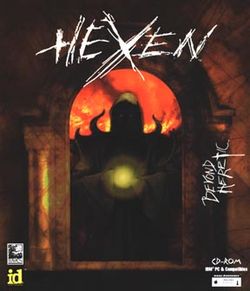
Hexen: Beyond Heretic

Game: Hexen: Beyond Heretic
Platform Played: PC 
Developer: Raven Software
Release Year: 1995
Stephen's Rank: 7/10

It's been a long time since I last posted! Having a baby plus a lot on at work has meant I've not had the time, but I fully intend to finish my blog and report on every game I've ever played.


Hexen is a first person shooter / role playing game developed by Raven Software.

Basic Plot

Following the events of Heretic the player travels to the realm of Cronos as part of a team of three heroes who seek to defeat the second Serpent Rider, Korax.

Gameplay

Hexen used the Doom engine and so by default was a first person shooter with additional functionality layered over top. The gameplay was similar to Heretic in most respects with some additional features:

  • Player character classes to choose from (fighter, cleric, or mage). Each character class had their own array of weapons and different physical characteristics; the fighter being the strongest and fastest but with little long range abilities, the mage being fragile but having powerful long ranged attacks, and the cleric being a blend of the two. The same item held by different classes could also produce different effects.
  • Unlike Heretic the game used a series of hub levels which the player would used to access other "side" levels but return to after. This allowed for large scale puzzles which involved interaction with multiple playable areas.
All in all the game was a first person shooter but with the addition of role playing mechanics such as items, abilities, and puzzles.


Comparisons

Of course, being the sequel to Heretic they are very similar to each other. For me, Hexen felt more epic. It took the game engine and twisted it enough so that it didn't feel like a generic first person shooter any more.

I can see some comparisons with Half-Life in the way they took the first person shooter genre but layered story and complex interactions that most other FPS games don't include.

It *almost* reminded me of Ultima Underworld... but had no-where near the depth of story or game mechanics.

Positives

Great music, fun to play, one of the most exciting games to be released at that time.

Negatives

I didn't play enough to find any for myself.

Memorable Moments

None.

Monday, 2 July 2012

Minecraft

Game: Minecraft
Platform Played: PC
Developer: Mojang
Release Year: 2011
Stephen's Rank: 8/10


Minecraft is the original sandbox adventure game which changed the way we think about games.

Basic Plot

There is no plot.

Gameplay

Regardless of what mode you play the game on there are some general principles which make Minecraft what it is:
  • The entire world is made up of 3D cubes of material somewhat like a giant lego world.
  • Different blocks have different properties and can be interacted with in different ways.
  • Some blocks can be harvested to obtain raw materials. These raw materials can be held in the player's inventory.
  • Raw materials can be combined in a number of ways to create complex tools, objects, and even engineering and electronics.
There are different modes of gameplay which provide the player with a different experience. Primarily there is survival mode and creative mode.

In survival mode the player joins or creates a random world to play in. You start with nothing except your bare hands and initially the goal is find food and shelter and survive. Gameplay is broken up into a fairly frequent day/night cycle. During the day the player is safe from enemy creatures and can focus on finding materials and food. At night time the player is encouraged to build or find shelter and wait for day time, as there are a multitude of enemy creatures who will try and attack the player on sight and even destroy their creations.

 An example of a player inventory. You can craft basic items from here in the space provided but you need a work bench to create complex recipes.

In creative mode the player is given a UI which allows them ot create an infinite number of any material. This is useful for creating masterpieces within the game engine. The objective isn't to survive, rather creative mode offers the player a canvas to create art.

The game is under constant development and from what I've read there will eventually be a way to beat the game, but for now it is truly a sandbox game which gives the player complete freedom to play in any way they choose.

Rather than talk in depth about the mechanics of the game I think it would be a lot more interesting to explore how we (myself and several others from Viva la Dirt League + my friend Matt) played Minecraft. We have a server hosted online and we play periodically. I'll cover that in the memorable moments section at the bottom

The work bench, used to create complex recipes.

You can also give your character custom skins which is always a source of entertainment. Mine is currently a Super Saiyan 3 Goku skin, while Hamish has a frog.

Comparisons

Obviously the closest thing I've ever played to this is Terraria which is essentially a 2D version of Minecraft. Terraria is slightly more adventure orientated and includes dungeons, boss monsters and quests which give it a slightly different feel.

Positives

Minecraft is a joy to play. It's deceptively simple from an initial glance, but has a lot of depth underneath. The vast array of recipes and interactions you can have with the world are immense and can provide you with many (many) hours of gameplay.

Multiplayer is the best. There's almost no point in creating wonderous works of art without someone to share it with.

Negatives

There is no online server for hosting your games, instead you need to set up your own server. This isn't an issue if you know how to open ports and set up a private server, or if you pay to have your server hosted, but if you don't know much about computers it can be a pain.

Memorable Moments

Myself and a group of friends have a server hosted online which we used to play a lot of.

We've set up a mini-town of sorts with different areas for different purposes. The areas are linked together with a powered rail which can be summoned from either end. I set up most of the rail and it was really fun. I highly recommend it! It makes any Minecraft town a lot more fun.

When we first started the server my friend Matt set up a basic base built into the side of a forested hill. We set up a basic living area with forges and work benches, chests for storage, and a wheat farm. We also dug a fairly winding mine shaft down to gather minerals.

From that area we built a tunnel which extends under the ocean a short way onto a large flat area of land. Here we decided to re-create the drama school that most of us went to for three years. It's a pretty unique building with a huge tall ceiling and lots of weird shapes and rooms, and it's still in progress. We call it "Te Whaea" which is the name of the building in real life.

A partially completed Te Whaea.

Next James and Paul set up a giant fortress in the middle of the ocean which looks like a giant head. I haven't had much to do with it but whenever I catch the train back to Te Whaea to see Matt... there it is, staring at me.

Then I had this "awesome" idea. I wanted to build a giant statue like the Collossus from Civilization but make it transparent and have light coming from inside it. I built a small base underneath and created a portal to the Nether. It turns out it looks freaking ugly and I hate it. I scorn the sight of it whenever I go past it now and will dismantle it in the future.

My failure of a statue.

Hamish creates his home base a fairly long way away in the side of a desert mountain area. It's huge and epic but the problem was it took us too long to meet up (this was before we laid down the rail). So we met half way and created a new home base. We included a vast array of farms with pigs, sheep, cows, chickens, wheat, watermelons, and bamboo up the top. A stone platform was our starting point and has become a sort of "hub" we use to catch trains and store items in a row of chests. There is a tunnel that goes through the mountain here toward Te Whaea but most importantly our mine shaft is in here. To get down you simply fall vertically to the bottom into a pool 3 tiles high of water. It's a rush every time I fall down. There's a second shaft with a ladder to the top and several exits at different levels; for example at the right levels for mining gold, diamond, or iron.

Hamish has extended the home base a lot including turrets, and we've linked all of our current and previous bases with a pair of railways. The goal is in the future to set up a circular railway which is always on with minecarts going past every few seconds. Then we can jump on from anywhere without having to call a cart.

Overlooking the top of our home base with the turrets and farmland visible. The mines are underneath. To the right in the distance you can see the transport hub with access to both railways and the storage chests. The stone path Hamish is on (he took the screenshots) is going to be part of the circular rail system.

Sunday, 1 July 2012

Black & White

Game: Black & White
Platform Played: PC
Developer: Lionhead Studios
Release Year: 2001
Stephen's Rank: 6/10


Black & White is an unusual strategy game developed by Lionhead Studios.

Basic Plot

The player takes on the role of a newly created god, created by the prayers of a small family. The player is then tasked at looking after the family with the help of his or her Creature.

The story kicks in when the player is introduced to another god called Nemesis. Nemesis is seeking to re-create the Creed so he can destroy all the other gods and become the one god to rule them all.

The player faces off against Nemesis by taking over villages and gaining pieces of the Creed until Nemesis is defeated leaving the player as the only remaining god.

Gameplay

The gameplay is pretty unique and doesn't have a lot of precedents before it. It plays out somewhat like a real time strategy game in that you are an external player who manipulates the world around them.

Here you can see the hand and a Creature.

The player's primary interaction with the world is the Hand. The hand follows the mouse cursor and is able to interact with many objects in the world including picking up and throwing objects (and people), casting miracles, knocking on houses to wake up the inhabitants, etc. The appearance of the hand changes depending on the actions the player takes (looking pure and clean if the player follows a strict no-harm policy to villagers, or red and spiky if the player commits evil acts).

The other primary form of interaction with the world is the Creature. Each god has a Creature which is a magical pet which can be trained to perform various tasks. The player trains the Creature by placing a leash on him while performing various acts with the Hand. The Creature AI remembers those actions and will repeat them automatically. Using this technique the player can train their Creature in any way they choose. Creatures grow in size and strength over time.

A lot of the gameplay involves taking over villages by performing miracles which cause the villagers to believe in you as a god. Other ways of winning over villages including providing resources such as food or wood, or creating a building.

As mentioned earlier the player gets a choice; whether to be a good and compassionate god or an evil twisted one. The choice is made by the actions the player takes, and the user interface changes depending on the player's alignment. Additionaly gods with different alignments will use different strategies in the game; a good god might provide care and help to a village while an evil god will strike fear into them in order to force them to obey. Villagers get immune to different kinds of miracle and help over time, so the player is forced to keep trying different tactics to impress them.

The player's temple, where the Creature sleeps and the player saves and loads their game.

There are two kinds of quests; golden scroll (primary) and silver scroll (optional). Silver scroll quests provide additional rewards which help the player advance.

Miracles are spells which the player casts with their hand. They cost worship or sacrifice to cast. To perform a miracle the player makes a Hand gesture which means the player has to remember the gestures for all the Miracles they know.

Comparisons

The fact that you play a god and are controlling the people not directly but indirectly reminds me of Populous 2.

Positives

Innovative idea, fun concept. Nothing like it out there (at the time).

Negatives

The story is a little weak.

For me the game missed the point of its own innovation. The story is actually quite restrictive and forces the player into situations where their freedom to explore is reduced significantly. I think this game would have had more success in a sandbox environment where there wasn't necessarily any story.

Memorable Moments

No matter how hard I tried I always ended up sliding toward evil alignment. It's very tricky to stop your Creature from accidentally eating villagers... It got too hard for me, I stopped enjoying it once I encountered other gods.