Sunday, 7 October 2012

Counter-Strike: Condition Zero


Counter-Strike: Condition Zero is a single and multi-player player extension of the popular team based multi-player on-line game Counter-Strike.

Developer: Valve Corporation, Gearbox Software, Ritual Entertainment, Turtle Rock Studios
Platform: PC
Release Year: 2004

Basic Plot

The original Counter-Strike did not contain a single player mode of game play, so this was new for the franchise. The original release came with a campaign called Tour of Duty. The plot loosely bound together various multi-player missions together into a basic story, utilising computer controlled team mates to simulate the team based mechanics of the on-line game.

Gameplay

In a nutshell, Counter-Strike: Condition Zero (referred to as CS:CZ) is a single and multi-player team based first person shooter. If you have never heard of the original game or simply want a re-cap on the mechanics of the game you can see my previous blog post here.

I'll talk about the mechanics of the single and multi-player aspects of the game separately, but there were also some game-play mechanics related to both.

Most obviously, the player and weapon models were re-worked for this game to be more detailed than the original game. It still used the same underlying engine (GoldSrc).

Single Player

The single player campaign simulated some of the experiences you might obtain during the multi-player part of the game but from the perspective of the Counter-Terrorists. Despite being single player, the game is heavily team-based and involves working together with a team of bots to achieve victory on each mission.

As the player progressed through the missions they were able to unlock new maps that they could play on, but most importantly could obtain more effective bot team mates to carry with them as they went.

The objectives of each mission were the same as multi-player, a combination of:
  • Defusing bombs
  • Rescuing hostages
  • Killing enemies
Playing through campaign provided a new player a decent introduction to the skills they might need to play against real players on-line.

An example of the updated game models.

Multi-player

The multi-player game functioned the same way the original Counter-Strike did but with the addition of new maps, weapons, and player models.

The multi-player part of the game never took off, and most players continued to play the original game after release.

Positives

It was a nice idea; to put a single player perspective to the game, provide a way for new players to learn the basics without being reamed by real players on-line, and to add some additional back story to one of the most successful games in history.

Negatives

The most memorable part of the game was how buggy it was. I gave up on the single player campaign after two attempts in which my save game got corrupted or part of the game glitched out and I was unable to proceed. As a bit of back story:
  • Development initially started in 2000 by Rogue Entertainment.
  • Later that year Rogue Entertainment went defunct, handing over development to Valve.
  • Valve handed development over to Gearbox Software (who developed Half-Life) so they could focus on Team Fortress 2 and the new Source engine.
  • Gearbox over-hauled the game to contain updated models and new weapons, but they missed their late 2002 release date and the development was handed over to Ritual Entertainment.
  • Ritual Entertainment completely re-started development and created a 20 mission single player campaign, and focusing on developing an updated AI system for bots, due for release in early 2003.
  • Valve released Ritual's version of the game to reviewers, but it received a rating of only 60%, so they scrapped all of Ritual's parts of the game and handed over development to the newly created Turtle Rock Studios.
  • Turtle Rock Studios took over from where Gearbox left off, and the final 2004 release was primarily focused on the updated models and weapons, as well as AI, but also included 12 missions which were left over from Ritual's development period.
It's no wonder the game was so buggy, with such a delayed development with so many vendors involved. For those of you interested, Ritual Entertainment's single player campaign was eventually released as Condition Zero: Deleted Scenes.

The multi-player aspect of the game didn't take off either. It didn't add anything significantly interesting to the mechanics of the game, and people preferred the tried and true original (plus it was less buggy).

An in-game cut scene from the single player campaign.

Memorable Moments

Like I said, I tried to play this game twice but the bugs prevented me from being able to complete it - very frustrating. I was pretty excited to try it out, as Counter-Strike was the most important game for me when I was at university, something I played many hours of every day.

Thursday, 27 September 2012

Duke Nukem II

Duke Nukem II


Platform: PC (DOS)
Developer: Apogee
Release Year: 1993


Basic Plot

It is the year 1998 and the evil Rigelatins are threatening to overthrow the Earth! As part of their dastardly plan they kidnap Duke during an interview (for his new book Why I'm so Great) to use his mind to help them plan their invasion. Instead, Duke escapes, and saves the world once again.

Gameplay

Duke Nukem II is the sequel to the original platform game of the same name and features an enhanced game engine.

For anyone who is not familiar with the Duke Nukem franchise, the game is a parody of itself; it is the quintessential mindless violent 2D platform action game. The character of "Duke" is cheesy and over-confident, and at least initially the whole package of the unashamedly cheesy action game was a hit with fans. The game has a nice blend of humour but is genuinely a fun game to play as well.

Gameplay is fairly similar to other 2D action games:
  • Travelling through a series of levels defeating enemies.
  • Picking up new weapons:
    • A flame thrower was his default, which was able to shoot through walls and boost him into the air!
    • The laser gun (my personal favourite) could shoot through anything, slaying multiple enemies in one shot.
    • A rocket launcher was the final weapon.
  • Also picking up power-ups including rapid fire, health kits for health (or points), and a cloaking device for temporary invincibility.
  • Key cards needed to be obtained to progress through levels, which was a very over-used mechanic in platform games at the time.
The ultimate goal is to beat your way through each level and fight the alien boss at the end.

The visuals were smooth and quite beautiful for the era.

The flame thrower could be used not only to attack enemies, but also boost yourself into the air.

Comparisons

Duke Nukem II fits into the "second generation" of platform games, competing alongside classics such as:
  • Sonic the Hedgehog
  • Alex Kidd
  • Super Mario World
  • Commander Keen
  • Jill of the Jungle
Comparitively, the Duke Nukem series was the one to contain satirical humour - it was an analysis of the genre as a whole and of computer game culture.

In terms of game mechanics it was quite a plain and uninventive game, even for the time. The opposing example would be Sonic the Hedgehog which re-defined a new style of fast-paced platform game which focused on agility and accuracy.

Positives

Light hearted and fun platform game, especially good quality for a PC game (at the time consoles had the pick of the games, and PC games were lagging behind).

Negatives

Linear story, uninventive game mechanics, not a game which made a big imprint on me as a child against a back-drop of other industry-shaping games which overshadowed it. I also never "got" the humour of the game in a way that some other people apparently did, it wasn't my personal taste.

Memorable Moments

I remember clearly the laser gun; it was the most satisfying weapon in the game. Nothing better than slicing a whole line of enemies with a single shot.

Wednesday, 26 September 2012

X-Men: Children of the Atom


Name: X-Men: Children of the Atom
Platform: Arcade (then PC)
Developer: Capcom
Release Year: 1994 (PC 1997)

Basic Plot
Magneto is on Asteroid M and the X-Men need to... actually just add in any plot from an X-Men game here. Loosely based on Fatal Attractions. It doesn't really matter.

What's its deal?
It's Street Fighter with X-Men characters.

Character select screen


Gameplay
It's a one-on-one 2D fighter from the good ol' days before team tag combos and 3D blah blah blah.
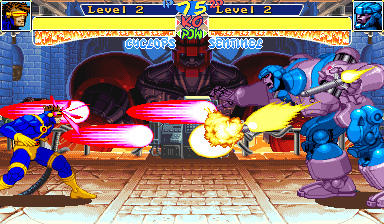
The first thing that struck you was how amazing the graphics were. The look and feel of the game was true to the X-Men 1991 comics run and the characters looked like they'd stepped right out of the comic panels (and animated TV series) and onto your screen. I love how they did not try to re-imagine the X-Men for this game or 'go in a new direction' and most likely fuck everything. No, you love the X-Men? Well here they are exactly how you have come to know and love them. Thank you Capcom. Thank you. The only exception to this was Sentinel, but they needed to make a new 'model' to fit on the screen and they made him badass so no harm, no foul.
Controls were exactly the same as SFII with 6 button attacks – 3 punches, 3 kicks. Special moves were your run of the mill 'fireball' and 'dragon punch' movements. Characters also had a 'rage meter' that would build up mutant energy during the fight allowing more powerful special moves to be unlocked including a powerful X attack. Again, these were all suited to the character so each one had their own unique play style. 
Even regular punches and kicks were suited to the characters eg) Cyclops' heavy punch threw out a small optic blast, Iceman's heavy kick threw up a wall of ice that could be used for offense or defence. The attention to detail was amazing. 

Iceman 'Arctic Attack'. Done real close, it destroys.

The 10 playable characters* were split between 6 goodies and 4 baddies:
  • Cyclops: sit back and keep em busy with optic blasts; play to his strengths man. His super X power was (wait for it) a giant optic blast! although he did also have a less powerful one but it could be aimed and moved once initiated; you could also bounce it off the floor. 
  • Psylocke: get in close and use those special attacks designed to link on from regular combos. She was a combo queen.
  • Colossus: one of my favourites. Play him as a wrestler. His special X attack sucked (just did a big diving head butt) much better to use his alternative 'super armour' power where he took less damage and just walked through attacks. Nothing like seeing the big man charging through and taking a smack in the face just to get in close and pile drive the enemy.
  • Iceman: a very versatile fighter. One of the most original special moves in the game was Iceman summoning a large ice boulder to drop down and smash on you. The cool thing about this power was it also could be used to shield you from projectiles if timed right.
  • Storm: her punches were laced with lighting and her kicks with tiny typhoons. She could also fly.
  • Wolverine: played like the brawler that he is. Lots of speedy hack and slash. His berserker barrage special X power looked pretty gruesome too.
  • Silver Samurai: Had one of the coolest special moves where his movements would trail – kind of like he had 5 shadows that would copy all his movements exactly a half second after him. So hitting a guy once would actually hit him 5 times. Very cool.
  • Spiral: I'm not sure why the hell they chose Spiral? You know, Mojo's number 2. Why not Sabretooth, Pyro, Toad etc? Oh well, she was the only character that could get a 6-hit combo from just using her heavy punch.
  • Sentinal: AWESOME. Every animation for every attack was awesome, he looked like he was transforming all the time with rockets coming out of his wrists and mouth and thrust kicks and shit. His movements were heavy and you really felt like a ton of metal raining down techno pain on your opponents. He could even launch mini Sentinels that did an aerial bombing run. Yes, you read that correctly.
  • Omega Red: If you mastered his coils, you were a force to be reckoned with. Having an option of 5 directions to launch a coil from (up, 45, straight, 45 down, down – last two need to be mid-jump) once it hit your opponent you had options. You could either just throw them around, drain their energy or drain a bit of their life.

*Ok, Akuma was also a hidden character but he can eat a dick. Piss off Akuma, you don't belong here. Don't you have like 500 other games to go and hide in?

Optic blasts Vs Rockets. Oh it's awwwn.

There were a few more game mechanics thrown in. Players could move around a little bit before the round actually started to vie for a good starting position. Every character could perform super jumps and dashes. Some stages had destructible floors eg) on Colossus' level you could smash your opponent through the street level and drop down into the sewers. Some characters had the ability to perform attacks on downed players – Wolverine could jump on top of a downed opponent playground-bully-style and punch them in the face with his claws. Colossus could pick people up from the ground and lift them over his head and then decide what to do with them.

There were two bosses. Juggernaut was the sub-boss and Magneto was the main boss. Once you finished the single player mode each character had their own little epilouge animation ala Street Fighter II.

Memorable moments
Probably having epic battles using Colossus. During his hyper-tackle move he is INVULNERABLE. I loved waiting for opponents to unleash their ultimate attacks and have Colossus just charge right through it taking no damage. Muhahaha eat it Magneto. Also Colossus Vs Juggernaut was always a big slug fest and I'll never forget the first time I picked up the Juggernaut over my head and then pile drove his ass. Good times.

Said Hyper-tackle.  Fav move in the game.

Positives
  • Was true to the X-Men comics. Everything was honoured, no stylistic raping at all
  • Was a damn good fighter, whatever your playing style
  • Each character was unique giving you lots of replay value
  • Looked amazing. Even the backgrounds were dynamic (danger room!)
  • Seriously fun
Negatives
  • Not enough characters! What? No Gambit!?

Extra comments
The success of this game lead to the start of the X-Men Vs Street Fighter series (which eventually led to Marvel Vs Capcom 3) Although they never made a strict sequel to this game which I would have loved to see. While these spin-off sequels were fun they lost the immersion into the X-Men universe and made the game more about wanky combos and underpowered special moves.
Unfortunately X-Men: Children of the Atom had a winning formula that no one used again – making it the Captain America of fighting games. Sigh.

Tuesday, 25 September 2012

Flashback


Name: Flashback
Platform: PC
Developer: Delphine Software
Release Year: 1992

Basic plot
You play as agent Conrad B Hart. Awaking in a jungle having had your memories erased you must regain your past and thwart an intergalactic alien conspiracy.

What's its deal?
It's sci-fi Prince of Persia with a gun.

Level 1 - techno jungle

Gameplay
Like I said, PoP with a gun. It's a platform action game with some puzzles thrown into the mix. You move from screen to screen like in PoP climbing, leaping, hanging and blasting baddies. 
The graphics were nice for the time (especially the backgrounds), the story was a little bit “huh? Whatever” but what was awesome though was the feel of being an action hero. 

The act of simply drawing your gun, having it at the ready, aiming, shooting, readying and finally holstering looked so cool you wanted to slow down and enjoy every battle, not just power through the game. 
Combining human-realistic athleticism and slick, secret agent style movements led to lots of Jason Bourne style kills and level navigation - “I'll leap over this chasm, go into a dive roll whilst simultaneously drawing my piece and smoke this sucka”. I'd find myself humming the Mission Impossible theme whilst clearing screens and even restarting from save points just so I could take out guys and a cooler way.

Memorable moments
Spending way too much time on interesting screens practicing ninja style, gun-fu moves long after I'd killed everyone.

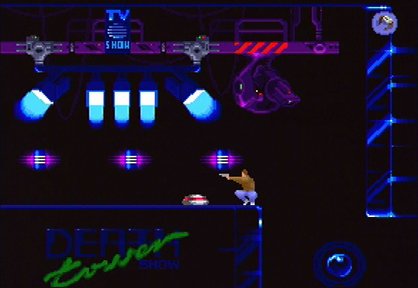
Death Tower had a very 'Total Recall' feel to it

Positives
  • Futuristic sci-fi setting is interesting with quirky little details (the subway system on level 2 taking you to 'continents')
  • One of the most satisfying games to fire your gun (gun sfx were gritty and loud too)
  • Nice mix of action and puzzle.
  • You feel like a FBI space ninja.
Negatives
  • Too short, only 7 levels.
  • Not enough enemies to kill, could have used a climactic fire fight.
  • It's French.

Extra comments
This was a really fun and satisfying game. Unfortunately it is tainted by its less successful (lame) sequel 'Fade to Black' where they tried to make Flashback 3D. This ambitious makeover took out all the fluidity of Conrad's movement and slickness. It was clunky and NOT FUN. Urgh.

Sunday, 23 September 2012

Blood

Blood


Game: Blood
Platform: PC 
Developer: 3D Realms, Monolith Productions.
Release Year: 1997

Setting

The setting is somewhat ambiguous but contains elements of post World War I Europe and America. The levels contain aesthetic choices from the 1920's - 1940's. This is strangely crossed with retro future-technology (reference to Tesla) as well as classic Western (including the background of the main character Caleb).

Basic Plot

You play a risen (undead) anti-hero from the Wild West era named Caleb. Originally Caleb was the commander of a cult called The Cabal who worshipped the god Tchernobog. He, along with four others, were the highest ranking members of The Cabal and were referred to as The Chosen. However, for an unspecified "failure" all four of The Chosen were betrayed and killed by Tchernobog. The game starts with Caleb rising from the grave. The original game is broken up into four episodes.

  • Episode 1: The Way of All Flesh: Caleb awakes from his tomb and immediately begins hunting Tchernobog's minions. Caleb hunts down and defeats the gargoyle Cheogh (one of  Tchernobog's minions), and cremates the body of one of The Chosen "Ophelia".
  • Episode 2: Even Death may Die: Caleb hunts down the spider demon Shial and defeats her. There he rips out the heart of the corpse of Gabriel (one of The Chosen) and absorbs his power.
  • Episode 3: Farewell to Arms: Caleb takes on the two headed beast (and second in command to Tchernobog) Cerberus and defeats him.
  • Episode 4: Dead Reckoning: Caleb fights his way to face Tchernobog himself. He ends up having to defeat his three lieutenants once again, before finally confronting the dark god. He finally learns why Tchernobog betrayed him; he knew Caleb would rise again and come back for him, absorbing power as he went, and Tchernobog wants the power for himself. Instead, Caleb states "It's time to put you down" and defeats the dark god - temporarily ending The Cabal.
The flair gun during the single player campaign.

Gameplay

Blood is a first person shooter based on the Build Engine. Although not true 3D (it used raycasting like technology seen in other games of the time such as DOOM or Wolfenstein 3D, it did include some voxel graphics for weapon pick-ups.

Blood was one of the last first person shooters I played purely with a keyboard (before the mouse + WSAD keys became the norm for PC games).

The single player campaign was interesting. It was littered with references to popular culture such as films, books, television, and various genres. It also featured a lot of blood and gore which makes the game fit into the "slasher" genre.

There were elements of puzzle solving as well.

Multiplayer LAN was one of the highlights of the game. The weapon options were spectacular and interesting, and some of the maps were pretty well designed too. The weapons included:

  • Pitchfork; the player's starting weapon, melee only.
  • Flare gun; a pistol which fired a flare which could "stick" to an opponent and continually burn them. An alternative fire could cause it to explode on impact.
  • Sawed off shotgun; always good at close quarters.
  • Thompson's machine-gun; standard automatic machinegun.
  • Aerosol can; used with a lighter to become a flame thrower. Powerful but you had to get close to hit an opponent. Could set the enemy on fire.
  • Napalm Launcher; fired a gooey projectile of death. When you get this weapon and fire it sometimes Caleb says "I love the smell of napalm in the morning".
  • Dynamite bundle; Used like a grenade.
  • Voodoo doll; Only in multiplayer, this weapon could either be used for a quick "stab" attack or a sweeping attack which could kill an opponent outright if they were close enough.
  • Skull staff (don't know the real name); this weapon was a skull on a staff which fired "hellfire" attacks at the enemy and was easily the most powerful weapon in the game.
  • Proximity mine; This mine had a sensor and if you stepped on it, it exploded. There was one multiplayer level called Click! which had a lot of these, was a small map, and often ended up with two players pretty much stuck until someone set off a chain reaction which almost eliminated everything on the level.
Voodoo doll.

Positives

The game was different, interesting. It had a really different feel to it even though it used a similar game engine to many others of the time. It had a lot of thought put into the back story and the connections with popular culture. The story was one of the better first person shooter stories out there, although still pretty linear in nature.

Multiplayer was amazing, it was something we played a lot of up until the age of real 3D games came along (particularly for is Half-Life Deathmatch). Going back from mouse+keyboard to just keyboard is PAINFUL.

Negatives

Having mouse + keyboard as an option would have extended the shelf life of this game for me.

Memorable Moments

Definitely the multiplayer level Click! was the most fun. I loved that... we knew where the spawn spots were and we'd lay mines down on them, so if you died you usually insta-died maybe 3-4 times before the mines were cleared.

I remember another level which had the skull staff, and there was a large spiral staircase up to it with a voodoo doll on the way. Lots of passages and positioning involved when we played that one.

I played this game a lot with DRTsorak (Rowan).

Wednesday, 15 August 2012

Descent


Game: Descent
Platform: DOS (PC)
Developer: Parallax Software
Release Year: 1995
Impact on my life: 3/10
Impact on the world: 5/10 (because of the use of 3D meshes)
Objective rating: 4/10


Basic Plot

A computer virus has infected mining robots who are gathering minerals throughout the solar system. The player is hired to travel outwards through the solar system eliminating the infected robots. The game takes the player right through the solar system to Pluto's satellite Charon. At the end of the game the player is informed that he cannot return to Earth; as their is a risk his own ship has contracted the virus.

Gameplay

Descent is a first person shooter in which the player controls a small mobile space ship.

Each level involves traversing a winding mine somewhere in the solar system, destroying infected robots along the way. The player must reach the centre of each mine and set off the reactor core, and escape before detonation. 

An optional objective was to pick up human miners who have been captured by the infected robots.

What makes this game unique is that the player has six degrees of freedom within a zero gravity environment. This means the player can move forward and backwards, turn left and right, bank left and right, and travel up and down. Here is an image which summarises the options for movement:

Six degrees of freedom; the movement in Descent involved all these axes.

This was a big change in comparison to other first person shooters of the time (for example DOOM). It meant the player had to consciously keep track of their position in the world (it was easy to get dis-orientated) and it also caused widespread motion sickness for a lot of players.

The game included 30 levels (3 of which are secret), additionally there was competitive multi-player support for up to 8 players over LAN.


Comparisons

This was one of the first games to render a fully 3D environment made up of meshes (as opposed to binary space partition which was used in DOOM and Wolfenstein 3D). It was a step up in terms of technology but it had a somewhat similar aesthetic to DOOM. Power ups and hostages were still rendered using sprites. The 3D technology was the same used for Quake a year later.

Relevance

Descent wanted to take the next logical step in the development of 3D graphics; to give the player complete freedom of movement in a real 3D environment. It was, however, a failed experiment. It turns out a player doesn't want *that* much freedom in a game as it makes keeping track of player position and navigation needlessly complex and difficult.

Positives


It was unique, something new, pushed the boundaries of what games could do at the time.


Negatives

The six degrees of freedom made the entire game dis-orientating and very difficult to play. I found it entirely un-enjoyable from the moment I first played until the moment I quit out of the game and vowed never to play it again.

Weak story.

Memorable Moments

None.

Squadron Tower Defense

Game: Squadron Tower Defense 
Platform Played: PC (Custom map for Starcraft II: Wings of Liberty)
Developer: Tsjnsn 
Release Year: 2011 
Impact on my life: 8/10
Impact on the world: 7/10
Objective rating: 7/10


I'm sad to say that the days of Squadron Tower Defence (Squad TD) may be over. After being easily the most successful custom map on Starcraft II for well over a year, Tsjnsn has handed of the reigns of development to Swentz and Eigonvalue, who have promptly started making major changes to the balance of the game and introduced a series of *really* bad bugs which have made the game unplayable. I've been playing Squad TD for ages for a reason, I don't want them to make all these changes, and in an act of defiance, I am going to go play something else :P

Also; someone messaged me about wanting some advice on their blog. I didn't catch your contact details! If you're still interested, e-mail me at: stownshend@gmail.com

Basic Plot 

There is no plot. The scenario is that there are two teams of four protecting their defence system (SS) from incoming waves of enemies. The teams interact by sending additional enemies to the other team.

Gameplay 

Squadron Tower Defence is a blend between a "tug of war" and a "tower defence" game. It is fairly complicated, so I'll go through each game mechanic step by step to build up a picture of how the game plays out.

  • Players are split in to two teams of four. Each team is responsible for defending a defence system located at the bottom of their side of the map (this is a Thor/Odin model). Each player has their own lane to defend, and all the lanes join up and lead to the defence system (SS).
  • The game is broken up (currently) into 31 waves of creeps. The creeps spawn at the start of the combat phase and will attempt to travel to the SS and attack it. After each combat phase is a build phase in which the player adds additional units to their squad.
  • Players attempt to stop the creeps from doing this by purchasing "towers" (which are actually units) who engage creeps during the combat phase and try to kill them. The combat phase is completely automated; the player has no control over their units.
  • Players pick a "race" at the start of each game. Each race has a different set of units they can build, and also different abilities. Some examples include; Beast, Elemental, Ghost, Shadow, Ancient, Celestial, Mechanical, Nature, and Automaton. Players can also pick "Random" to get a random race, and more recently there are various incarnations of "Chaos" in which players receive a random race each round. Later on players can unlock the "custom" builder in which they can pick and choose units from any race (within limits, based on a points system).
  • Each player controls a single builder unit for the majority of the game. Builders can build six different kinds of initial unit which are categorised into "tiers". The lower the tier, the cheaper the unit is, but the less powerful it is. It's not quite that simple; as a good unit composition will contain a balance of melee/tank units as well as long range damage dealers.
  • Units cost supply, and players need to spend some minerals and gas to extend their maximum supply.
  • Units can be upgraded, sometimes in to various different forms. For example; a Bone Warrior (from the Shadow race) can be upgraded into a Dark Priest, a Fire Archer, or a Skeletor.
  • Players have both mineral and gas income:
    • Gas is gathered by gatherers who travel between your command centre and a gas geyser throughout the game. Gas can only be spent on sends which are additional units which will be sent to the enemy team on the next round. Every send you do increases your mineral income for all subsequent rounds; so getting a high gas income is also the secret to having a high mineral income.
    • Minerals are used to purchase all units, as well as upgrades, and additional gatherers. There is a careful balance between investing in additional workers (which will increase your income in the long term) or purchasing more units to defend. The ideal situation is to *just* buy enough units to survive each round, and purchase additional gatherers with the remainder. Players can obtain a maximum of 30 gatherers and can upgrade their speed as well to a maximum of 5 times. Minerals are obtained at the end of each round based on the "income" of the player (defined by what sends they've done) as well as directly by killing creeps and enemy sends. Sends range from a Zergling which costs 20 gas, to a Thor which costs 600.
    • Not all sends give the same income! Some sends give less mineral income per gas spent, but often have special abilities which make them more likely to make an enemy player "leak" their creeps.
  • The game ends when one team's SS is destroyed or the enemy team has no remaining units. The SS itself can be upgraded to have additional defence and attack (as it can engage enemies which try to attack it). Any unit killed by your SS gives the other team extra minerals, so you don't want to leak creeps. The SS can be micro managed by a player on the team to focus on weaker/important units.
  • When a player's units finish destroying a wave of creeps, they walk into a teleporter at the back of the lane and appear in front of the SS ready to defend it in-case another team member "leaked".
  • Additionally, if creeps escape your immediate lane, they get a +2 armour bonus meaning they're harder for team-mates to clean up at the SS.
  • If no-one wins by Round 31, it will turn to sudden death and the wave will repeat itself infinitely until one team is eliminated (and players cannot re-built between waves).
An example of a squad of units defending a lane. Creeps will spawn from above.

The strategy of the game involves:
  • Balancing your income carefully; getting the most workers (gatherers) you can without leaking. Ideally you want to max out your workers as soon as possible, and then focus on building an unstoppable defence.
  • Working out unit builds which facilitate the above. Not all units are equal, and there are various combinations of units which can help you get that economic edge. Back in "the day" a good example was "Aqualing" which was the use of Zergling Warriors and Aqua Spirits together.
  • Hitting the enemy team when it hurts. This could simply be about knowing which rounds are particularly tough to defend, and getting everyone to send extra units on that wave. It's also about making a decision when it is cost effective to send units which don't give optimal income but will probably cause the enemy to leak.

It sounds complicated, and it is for the first 2-3 games, but then it becomes pretty instinctual.

An SS (defence system) being destroyed.

Players can see their wins/losses including the ratio, there is also an interface for looking at the income of you and your team mates.

Comparisons 

It has some similarities to Colonial Line Wars, another Starcraft II custom map I used to play. It also has some aspects in similar with lane based games like Defence of the Ancients or League of Legends but instead of the focus being around a hero unit, it is on building defence and sending extra creeps to the enemy. Also, it does remind me of Nexus Wars. In saying that, it is different enough to all of these to be a game in its own right; its own genre.

Relevance 

Hard to talk about relevance to the world or even the gaming world here, but this game hit a note with a lot of people. This has been the most popular custom map on Starcraft II for a *very* long time and I wouldn't be surprised if it became a standalone game in the near future (like Dota 2).

Positives 

Addictive, relaxing, enjoyable... it's a really good game. It's the kind of game that anyone can be good at, you just need to watch some replays and find a good race and a few builds which work for you.

Negatives 

It's always been updated a LOT and often is quite buggy. A lot of the players are absolute ass holes. There are some really nice people too, but then there's people who just join the game to troll. I also wish it was 2v2 because it's *very* hard to get matched up with 3 other players who know what to do and/or are not ass holes. I don't even bother playing unless DRTwoadism is on as well. Usually together we can make enough of an impact to win even if our team mates are hopeless.

Memorable Moments

I've played this game hundreds, maybe thousands of times. I've put more hours into it than the vanilla SC2... and I've tried a lot of different builds and strategies from middle building to going eco, or doing crazy builds which rely on a particular ability to trigger in order to win. Regardless of how the map changes now that Tsjnsn is gone... I'll always remember this game fondly.